“Fate,“ Blue replied, glowering at her mother, “is a very weighty word to throw around before breakfast.”
People have been recc’ing these books to me for ages, and this year I finally got around to reading them! Don’t be put off by the “YA supernatural romance” marketing – this is a surprisingly complex series with well-drawn characters, an intricate plot, and an abundance of clever twists and turns. Stiefvater also does a great job at blending real-world issues (domestic abuse and poverty) with fantastical themes (a house of psychics and a mythical king sleeping under a hill). It swept me up to the point where I managed to finish all four books in under two weeks, which is pretty unprecedented. If you’re trying to be productive, maybe wait a while before diving in. If you’ve got nothing much to do, then pick up the first book and let yourself get immersed in Stiefvater’s world of fortune-telling, haunted forests, ley lines, and dreams that can come alive.
How to be Both by Ali Smith
“All we are is eyes looking for the unbroken or the edges where the broken bits might fit each other.”
Ali Smith is one of the more prominent lesbian novelists working today, and although her style isn’t for everyone, I personally love it. This book has two parts to it, which can be read in either order – one focusing on George, a 21st-century girl coming to terms with her sexuality and the death of her mother, and the other centred around Francesco, a Renaissance-era painter who disguises herself as a man to pursue an artistic career. The prose is pretty abstract, particularly in the Francesco section, so if you like stream-of-consciousness then this might be a good one for you. There’s some paranormal elements – hints of time travel, a possible government conspiracy – but at its core, it’s just a witty and profoundly human novel about art, gender, and connections that surpass the boundaries of time and space.
The Traitor Baru Cormorant by Seth Dickinson
“This is the truth. You will know because it hurts.”
Fair warning: this book will rip out your heart and stomp on it. Multiple times. The premise is “high finance meets fantasy imperialism”, which might not sound compelling at first blush, but trust me – you’ll be hooked before you know it. “The Traitor Baru Cormorant” is a story about love, war, power, and sacrifice, and at the centre of it all is Baru herself, a gifted chessmaster and social climber who will do whatever it takes to free her colonised people. She’s easily one of the best fantasy protagonists I’ve read, and the other characters are all equally compelling. If you’re prepared to hack your way through the thicket of double-crossing and thorny economic manoeuvring, you’ll be well rewarded.
The Long Way to a Small Angry Planet by Becky Chambers
“Ninety percent of all problems are caused by people being assholes.” “What causes the other ten percent?” asked Kizzy. “Natural disasters,” said Nib.
Think “Guardians of the Galaxy” meets “Firefly”, except with lower stakes and more of a socio-political bent. It’s less about plot and more about the relationships between characters, so if you prefer action this might not be the book for you. However, if you like intricate world-building and The Power of Friendship, then go wild! I can’t reveal much without spoiling the book, but I can tell you that there’s a beautiful queer love story at the heart of it, and the author does a fantastic job of exploring alien genders and sexualities in a way that never feels ham-fisted or shoehorned in. The sequel, titled “A Closed and Common Orbit”, is also fantastic and can be read as a standalone.
Fun Home by Alison Bechdel
“My homosexuality remained at that point purely theoretical, an untested hypothesis. But it was a hypothesise so thorough and so convincing I saw no reason not to share it immediately.”
Alison Bechdel always produces quality stuff, and this is (in my opinion) one of her best works. It’s an autobiographical graphic novel, focusing on the young Alison as she tries to reconcile her feelings about her late father – who, as she discovered after his death, had been closeted all his life – with her childhood memories of him. It also examines Alison’s own lesbianism and her difficult relationship with gender, delving deep into psychology and queer theory along the way. Well worth a read.
The Argonauts by Maggie Nelson
“Just as the Argo’s parts may be replaced over time but the boat is still called the Argo, whenever the lover utters the phrase “I love you,” its meaning must be renewed by each use, as the very task of love and of language is to give to one and the same phrase inflections which will be forever new.”
More academic than the other books on this list, “The Argonauts” deliberately sidesteps the question of genre – although it could loosely be described as an autobiography with a smattering of literary theory and history thrown in. It is written from the perspective of a cis woman (Nelson) in a relationship with a nonbinary trans man (artist and writer Harry Dodge). Then again, Nelson herself would likely object to these labels on the grounds that they are too limited, or too restrictive. Much of “The Argonauts” is about fluidity – fluidity in language, in identity, in sexuality, in gender, and so on. It’s not quite an all-you-need-to-know pack for aspiring queer theorists, but it’s certainly a good place to start.
Nimona by Noelle Stevenson
“Halt, you villains! Unhand that science!”
The LGBT+ themes are pretty understated in this, but I loved it so much that I’m adding it anyway. You probably already know Noelle Stevenson from her webcomic or from the cartoons she publishes as gingerhaze, but if you haven’t read “Nimona” yet… seriously, put it on your list. I normally struggle to get through graphic novels, but this one hooked me right from the get-go. It plays around with the traditional fantasy dichotomy of “good/evil”, and turns a lot of tropes neatly on their heads.
It’s hilarious, sweet, moving, action-packed and compulsively readable, with a cast of characters that always feel very human – even when they’re anything but.
The Gloaming by Kirsty Logan
“Magic was real and the girls roamed wild as cats.”
This came out pretty recently, and I’d say it’s up there as one of the best books I’ve read in 2018. A blend of magic realism and fairy-tale, it follows the characters of Mara – a teenage girl who lives on a magical island with her family – and Pearl, a part-time mermaid with whom Mara forms an instant bond. The premise might seem strange, but Logan’s haunting prose and matter-of-factness quickly suspend disbelief and allow the themes of love, loss, and belonging to rise to the fore. Logan’s depiction of a broken family and the headiness of first love is also note-perfect. Its spiritual predecessor, “The Gracekeepers”, looks equally good. And equally gay. (Insert gif of “Shut up and take my money” here.)
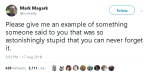
why does every father have the emotional intelligence of a flea
toxic masculinity
Not my dad, shut it
Okay it’s great that your father doesn’t fall into this category – my father doesn’t, either – but I don’t think that’s a very good reason for telling others to shut it.
Because it says “every father”, and I’m not here for that. I’m not here for making that an expectation, or making it normal. Some fathers, maybe. Not every father.
if your father was so great why’d he raise such a dipshit
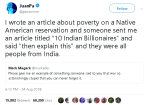
“The US military would desert if ordered to fire on citizens” is a form of Stockholm Syndrome and needs to be broken.
Like… they’ve done it almost every time they’ve been asked to. The National Guard have been called on to put down riots and insurrections hundreds of times in history. They’ve massacred thousands over the years. On only a few rare occasions, all of them before the 20th century, did any National Guard refuse, desert, or mutiny. And even then only some, not all of them.
drone operators have killed hundreds of US citizens deliberately over the past decade
The amount of lesbians who know that they’re lesbians from a young age versus the amount of gay men who know that they’re gay from a young age shows a staggering difference in that most lesbians take way longer to realize that they’re gay.
Girls are told that dating men is supposed to be hard and essentially unfulfilling. That it’s normal to expend emotional and sexual labor without receiving anything or feeling anything in return. Girls are told that their attraction to men and relationships with men should be difficult and sometimes feel forced because men are so emotionally lacking or otherwise “hypermasculine”.
Realizing that you don’t like men because you’re gay versus just feeling emotionally exhausted or unable/unsure of how to “please” men is part of the reason why compulsory heterosexuality is so damaging. It forces many girls to continue to date men and to keep trying to feel attraction to them long after they’ve realized that there’s nothing there—particularly blaming themselves for the reasons why relationships with men don’t work out instead of thinking it’s an indicator of being gay, which most (though of course not all) gay men are able to recognize as an initial indicator early on.
On a different but still related note:
I think the thing that used to trip me up more than anything was how hypersexualized women are. It sounds ridiculous in hindsight, but as a teenager I genuinely believed that every single human being on the planet agreed that women are inherently more attractive than men. I thought like this because it was an easy way to rationalize why the world around me seemed so much more fixated on female bodies than it was with male bodies. I wasn’t old enough or educated enough yet to realize that the individuals and corporations around me were trying to cater to heterosexual men. So I just assumed that 100% of us had those kinds of fantasies about women, even if we were straight women ourselves (hah!). I was never challenged to examine my own feelings on the sexuality of women because so much of the media was proudly and openly obsessed with the sexuality of women.




 My blog except its not tumblr